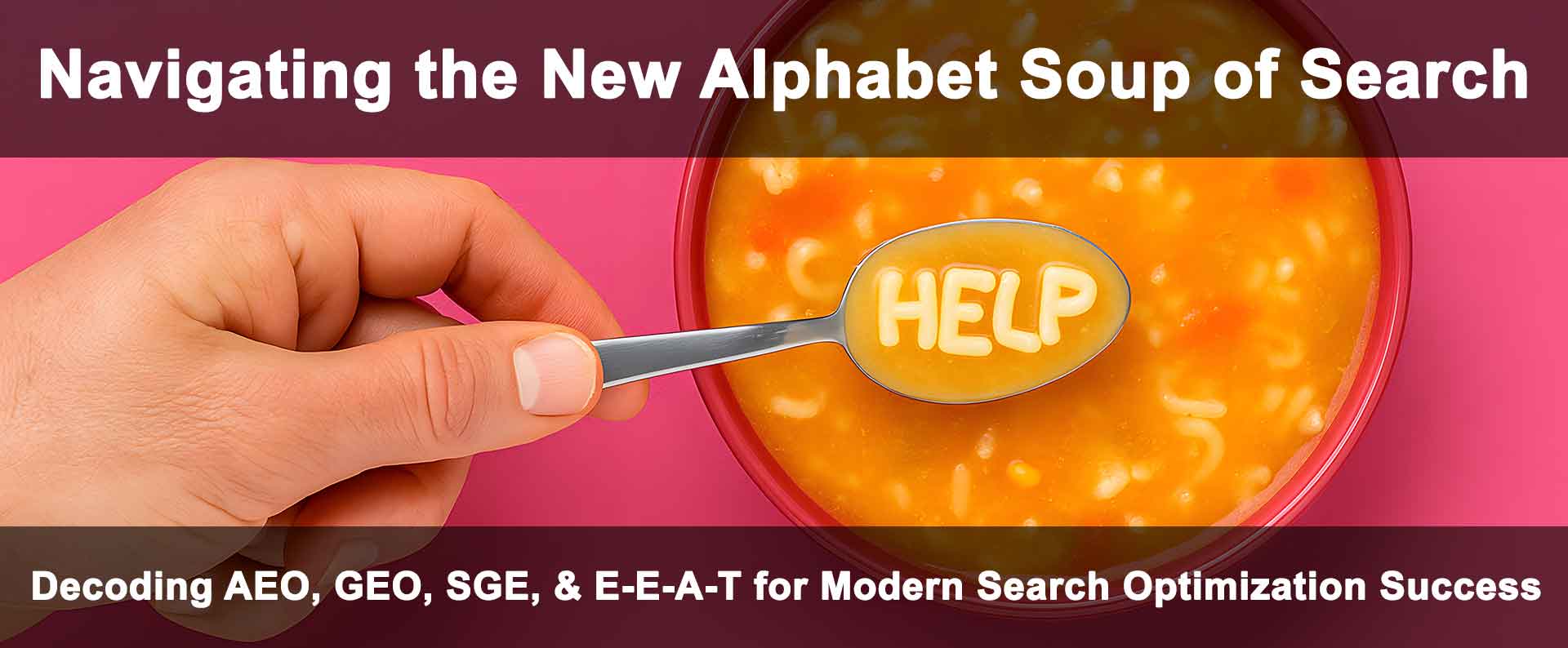
For over two decades, Search Engine Optimization (SEO) has been the cornerstone of online visibility, but the advent of artificial intelligence is ushering in a particularly transformative, important, yet complex acronym-rich era.
Business owners are now hearing terms like AEO, GEO, SGE, and E-E-A-T and wondering if they need to learn a whole new language.
The answer is yes—but these aren't replacements for SEO. They are powerful, complementary strategies that, when understood and integrated, can dramatically amplify your marketing results across both digital and traditional channels.
Here we will demystify these concepts, explain their unique roles, and illustrate how they integrate into a powerful, comprehensive marketing strategy.
Unpacking the Terminology: What's What?
Let's begin by defining each term, as some, like AEO, can have multiple meanings depending on the context.
- SEO (Search Engine Optimization):
This is the foundational practice of improving a website's visibility in search engine results pages (SERPs) to attract organic (unpaid) traffic. The primary goal of traditional SEO is to rank high for relevant keywords, encouraging users to click through to your website. Think of it as ensuring your storefront is visible on the busiest street.
- AEO (Answer Engine Optimization) – The Information Provider:
This refers to optimizing content to directly answer "zero-click" queries. These are searches where users find their answer directly within the search results, often in featured snippets, "People Also Ask" sections, or voice search responses, without needing to click through to a website.
Example:
A restaurant optimizing its hours and menu items to appear directly in a Google Maps query when someone searches "pizza near me open now."
- GEO (Generative Engine Optimization):
This strategy focuses on creating authoritative, in-depth, and well-structured content that AI models can use as a trusted source to synthesize complex responses, generate summaries, or even create new narratives. GEO aims for your brand to be cited or recommended within broad, conversational AI interactions, positioning you as a thought leader.
Example:
A healthcare provider publishing comprehensive, evidence-based articles on specific conditions, making them a go-to source for AI when explaining medical topics.
- E-E-A-T (Experience, Expertise, Authoritativeness, Trustworthiness):
These are Google's critical quality guidelines used to evaluate the credibility and reliability of content and its creators. High E-E-A-T signals to both traditional search engines and AI models that your content is trustworthy enough to be used, cited, or ranked highly.
Example:
A law firm showcasing its lawyers' credentials, client testimonials, and publishing well-researched legal guides to demonstrate expertise and trustworthiness.
- SGE (Search Generative Experience) / AI Overviews:
This is Google's specific implementation of generative AI directly within its search results page. SGE provides AI-generated "Overviews" at the top of the SERP, summarizing information and sometimes offering follow-up questions. It's a platform where AEO and GEO strategies are applied to appear in Google searches; it's a specific product, not an optimization strategy itself.
Example:
When searching for "how to choose a general contractor," SGE might provide an AI Overview summarizing key considerations, potentially drawing information from construction company blogs or guides that have effectively implemented GEO.
- AEO (Agentic Engine Optimization) – The Task Enabler:
Distinct from Answer Engine Optimization, this "Agentic" AEO focuses on optimizing content, data, and APIs (Application Programming Interfaces) for autonomous AI agents. These agents perform tasks and make decisions on a user's behalf (e.g., booking a flight, scheduling a meeting, making a purchase). This requires machine-readable data, clear API documentation, and actionable endpoints that allow AI to interact directly with your services.
Example:
A hotel making its booking system API accessible and clearly documented so an AI travel agent can directly check availability and book a room for a user without human intervention.
Integrating AI Strategies into Your Marketing Ecosystem
These aren't isolated tactics but rather complementary components of a robust, multi-channel marketing strategy. They reinforce existing efforts and open new avenues for visibility.
- Foundational SEO:
Remains paramount. Without a strong SEO base, your content won't even be discovered by AI models. Ensure technical SEO is sound, keywords are targeted, and content is well-structured.
- E-E-A-T as the Cornerstone:
This is the bedrock for both AEO (Answer & Agentic) and GEO. Consistently demonstrating experience, expertise, authoritativeness, and trustworthiness will make your content more likely to be used by AI and trusted by users. This involves transparent author bios, fact-checking, and securing reputable backlinks.
- AEO (Answer) for Immediate Visibility:
Target common questions related to your products or services. Structure your content with clear headings, bullet points, and concise answers to common queries. Think Frequently Asked Questions (FAQs). This ensures you appear in "zero-click" answers and voice search.
- GEO for Long-Term Authority:
Develop comprehensive guides, in-depth articles, and data-rich resources that cover broad topics within your industry. Aim to become a definitive source that AI can confidently cite when synthesizing complex information.
- AEO (Agentic) for Future-Proofing:
Businesses need to think about how AI agents will eventually interact with their services directly. This means investing in well-documented APIs, structured data (like Schema Markup), and clear digital pathways for AI to complete tasks on behalf of users.
Industry-Specific Applications & Benefits
Let's explore how different SMB industries can leverage these strategies:
Retail:
- AEO (Answer):
Optimize product descriptions and FAQs to answer specific queries like "best running shoes for flat feet" or "return policy for electronics."
- GEO:
Create buyer's guides (e.g., "Ultimate Guide to Home Brewing Equipment") that AI can reference when users ask for product recommendations.
- AEO (Agentic):
Develop APIs for inventory lookup or direct purchasing, enabling AI shopping assistants to find and buy products for users.
- Benefit:
Enhanced product discoverability, increased direct sales via AI, and positioning as a helpful resource.
Restaurants:
- AEO (Answer):
Ensure accurate and structured information for hours, menu items, dietary options, and reservation availability, making it easy for "near me" and voice searches.
- GEO:
Publish articles about sourcing ingredients, local food history, or unique cooking techniques to establish culinary authority.
- AEO (Agentic):
Integrate with reservation platforms via API, allowing AI agents to book tables directly for users.
- Benefit:
More direct bookings, increased local visibility, and a reputation for culinary excellence.
Hospitality (Hotels, B&Bs):
- AEO (Answer):
Optimize for queries like "hotels with pet-friendly rooms in [city]" or "amenities at [hotel name]," ensuring direct answers.
- GEO:
Create destination guides, local event calendars, or articles on regional attractions, establishing your property as a local expert.
- AEO (Agentic):
Provide APIs for room booking, checking availability, or requesting services (e.g., "order room service") to facilitate AI-driven guest experiences.
- Benefit:
Streamlined bookings, improved guest satisfaction through AI services, and increased visibility for destination travel.
Construction:
- AEO (Answer):
Answer specific questions like "cost to build a deck" or "permits for home renovation in [city]" in concise formats.
- GEO:
Publish detailed guides on various construction processes, material choices, or project management tips, showcasing expertise.
- AEO (Agentic):
While less direct currently, consider APIs for lead qualification (e.g., a chatbot collecting initial project details) or scheduling initial consultations.
- Benefit:
Establishing industry authority, attracting qualified leads through informative content, and simplifying initial client interactions.
Healthcare (Clinics, Practices):
- AEO (Answer):
Optimize for direct answers to "symptoms of [condition]," "how to prepare for [procedure]," or "appointments available with [doctor name]." Crucially, ensure all information is fact-checked and medically accurate to maintain E-E-A-T.
- GEO:
Develop comprehensive, peer-reviewed content on specific health conditions, treatment options, or wellness advice, positioning the practice as a trusted medical resource.
- AEO (Agentic):
Integrate with appointment scheduling systems via API, allowing AI to book consultations or refill prescriptions (with proper security and consent).
- Benefit:
Enhanced patient education, improved trust, efficient appointment scheduling, and broader reach for health information.
Professional Services (Legal, Accounting, Consulting):
- AEO (Answer):
Optimize for questions like "what is power of attorney?" or "small business tax deductions," providing concise, accurate answers.
- GEO:
Publish in-depth whitepapers, case studies, or legal guides on complex topics, demonstrating profound expertise and thought leadership.
- AEO (Agentic):
Provide APIs for scheduling initial consultations, submitting document requests, or automating routine client communications.
- Benefit:
Attracting highly qualified leads, cementing authority in specialized fields, and streamlining client onboarding and service delivery.
A Powerful Ally for Existing Channels
When used effectively, these AI-driven optimization strategies are not replacements but powerful reinforcements for your traditional and digital marketing.
- Reinforcing Traditional Marketing:
A billboard or print ad might spark curiosity; an AI-powered search (optimized via AEO/GEO) can then provide immediate, detailed answers or even facilitate a direct booking, bridging the gap between offline interest and online action.
- Enhancing Digital Marketing:
Paid ad campaigns (Google Ads, social media) drive traffic, but AEO ensures that when users search directly for follow-up information, your brand is the immediate answer. GEO amplifies content marketing efforts by ensuring your valuable insights are picked up and cited by AI, extending their reach far beyond traditional blog readership.
- Lead Generation & CRM:
Agentic AEO, in particular, can automate initial lead qualification, information gathering, and even scheduling, feeding warm leads directly into your CRM systems, allowing your sales team to focus on conversion rather than initial outreach.
- Marketing Automation:
By integrating your services with AI agents, you can automate more complex customer interactions, from booking confirmations to personalized recommendations, improving efficiency and customer experience.
Tracking Outcome & Conversion Effectiveness
The ultimate measure of any marketing strategy is its impact on business goals. For AI-driven optimization, tracking outcomes requires integrated funneling.
- Attribution Models:
Employ sophisticated attribution models to understand how initial AI interactions (e.g., a "zero-click" answer or an AI-generated summary citing your brand) contribute to eventual conversions.
- API Usage Analytics:
For Agentic AEO, track API call volumes, successful transactions, and user journeys initiated by AI agents. This provides direct evidence of AI-driven lead generation and service fulfillment.
- Website Analytics:
Monitor direct traffic increases after appearing in SGE overviews, track engagement metrics for content optimized for GEO, and analyze user behavior after an AI interaction directs them to your site.
- CRM Integration:
Ensure that leads generated or nurtured through AI interactions are accurately tracked within your CRM, allowing you to measure their conversion rates and lifetime value.
The Take Away
The AI revolution is not just for tech giants; it presents immense opportunities for small and medium businesses to elevate their digital presence. By understanding and strategically implementing SEO, AEO (Answer & Agentic), GEO, and E-E-A-T, businesses can ensure they are not just present, but prominent, in the evolving search landscape.
This requires a unified, forward-thinking approach that prioritizes credibility, clear information, and future-ready service delivery. For businesses navigating the complexities of modern marketing, embracing these concepts is not merely an advantage—it's an imperative for sustainable success.